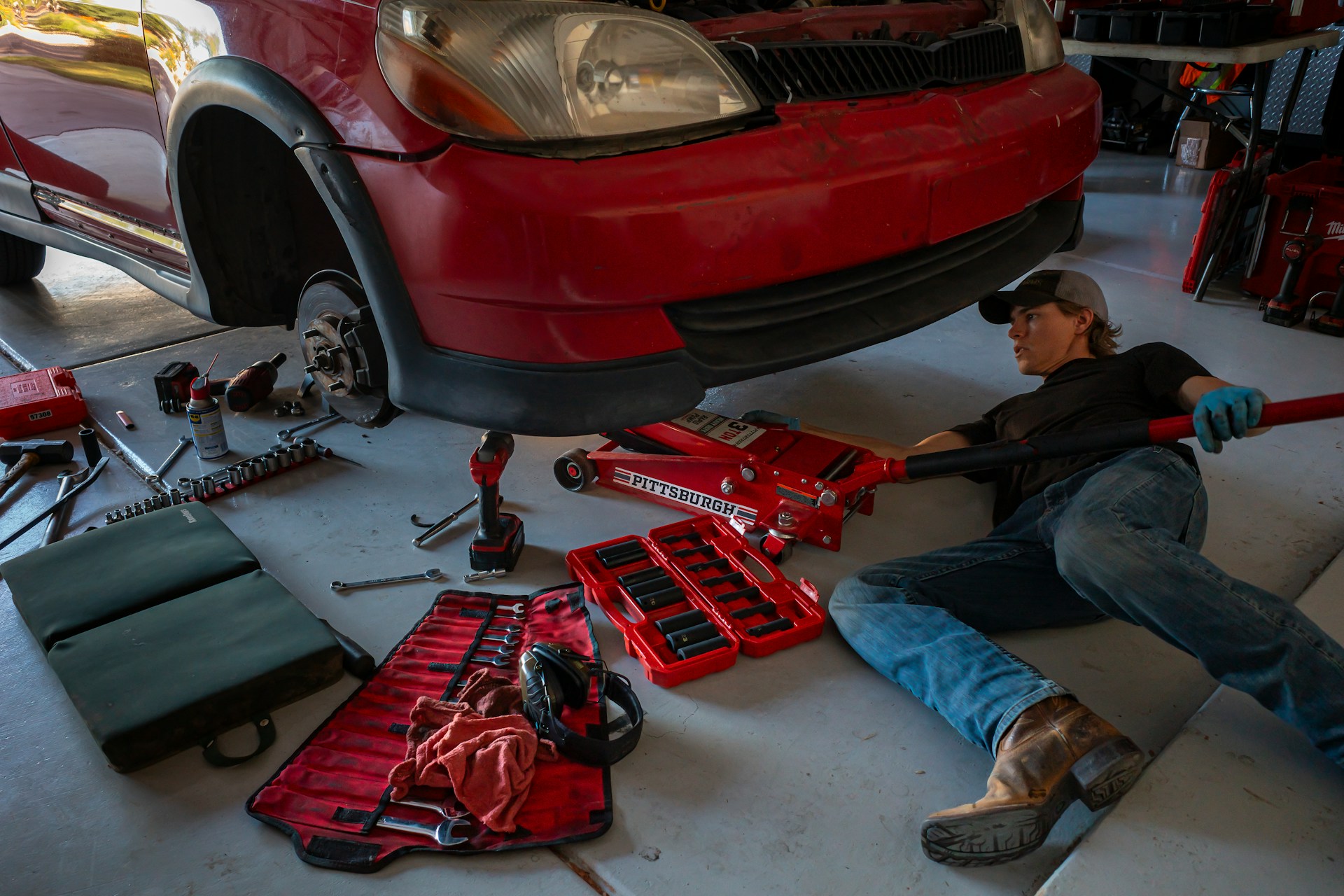
Whether you wrench on a low-slung sports car, a lifted off-road rig, a motorcycle, or your everyday commuter, having the best floor jack for the job is about more than convenience—it’s about safety and confidence. Not all vehicles lift the same way, and the jack that works perfectly under a pickup can be useless under a Porsche, just as a lightweight motorcycle jack won’t inspire much trust beneath a full-size SUV. Choosing the best floor jack means understanding clearance, lift range, capacity, and stability across very different platforms. From daily drivers that need quick tire rotations, to off-road builds with oversized tires, to sports cars with fragile aero and tight pinch welds, the right jack turns routine maintenance into a smooth, controlled operation instead of a white-knuckle gamble.
I’m not sure how we didn’t cover these in our article about the best shop tools for the home mechanic, but since we didn’t cover this topic there, we’ll dive in deep here.
This article contains Amazon Associate links. As an Amazon Associate, we earn from qualifying purchases at no additional cost to you.
Choosing the Best Floor Jack for Off-Road Vehicles
Let’s start off with the most demanding application first. ff-road vehicles present a unique challenge when it comes to lifting. Larger tires, suspension lifts, skid plates, and rock sliders all change where and how a vehicle can be safely raised. A compact, low-profile jack designed for sports cars simply won’t reach the frame or axle of a lifted truck or SUV. For these rigs, the best floor jack is one with both a higher minimum reach and a much taller maximum lift.
To be clear, this isn’t about Hi-Lift or farm jacks. Those have their place on the trail for recovery and emergency situations, but they’re not what you want in the garage. A proper high-lift floor jack gives you the vertical range you need while keeping the vehicle stable and controlled. Many off-road vehicles sit 10 inches or more off the pavement at the jacking points, and once the suspension droops, you may need 20 inches or more of lift to fully clear a tire. A tall floor jack with a long throw lets you do that without stacking unstable objects or relying on improvised setups.
If your current jack doesn’t quite have enough height, there are ways to safely gain a little extra reach. Placing a solid 4×4 block or stacked 2×4s between the jack pad and a flat, reinforced jacking point on the frame can buy you a few crucial inches. The key is that the wood must be square, solid, and stable, and the jack must remain centered and vertical under load. Also, don’t use pieces that have any obvious splits in them. This isn’t a substitute for owning the right tool, but it can be a safe, practical workaround in a pinch—far better than trying to balance the jack on bricks, rocks, or scrap metal. We did this for years with no problems.
Capacity and stability matter just as much. Off-road rigs are heavy—often far heavier than they look—once you account for steel bumpers, winches, roof racks, and gear. The best floor jack for these vehicles will typically be rated at 3 tons or more, with a wide stance and large casters that roll easily under load. That combination lets you lift confidently from axles or frame rails without the jack feeling tippy or overworked. For anyone running a 4×4, a tall, high-lift floor jack isn’t a luxury—it’s a necessity.
Choosing the Best Floor Jack for Sports Cars (or Cars With Lower Ground Clearance)
Sports cars and performance vehicles often look great — until you try to get a conventional floor jack under them. Low ground clearance, delicate bodywork, and chassis components that sit close to the pavement create a very different set of requirements than a lifted truck. For these cars, the best floor jack isn’t just about lifting capacity — it’s about low minimum reach, precise fitment, and stability without scraping the pinch welds or belly pan.
Unlike the off-road section where you’re after tall lift range, here you’re chasing low clearance capability. Many standard jacks start too high — their saddles simply don’t slide under a front spoiler or side skirt without damage. That’s where a low-profile floor jack shines: with a minimal starting height often several inches below a standard jack, it lets you gain purchase on structural lifting points without risking cosmetic or structural harm. These jacks typically have a shorter lift range than tall off-road models, but they make up for it by fitting under cars others can’t touch.
Another point worth emphasizing is that this still isn’t talking about unstable “DIY” lifts or scissor jacks. Even for sports cars, you want a proper floor jack with a broad, stable base and quality hydraulics. A floor jack rated for 2–3 tons with a low profile gives you the control you need whether you’re changing tires before a track day or doing detailed underbody work.
If your current jack almost fits but not quite, there are safe interim workarounds much like with lifted rigs: placing a solid plank (like a squared 4×4 or hardwood board) between a low lift point and the jack saddle can elevate the jack just enough to make contact without scraping. The wood must be flat, stable, and aligned squarely under the jacking point — and this trick should only be used briefly, not as a substitute for the right tool.
The bottom line is this: for low-slung cars, the right floor jack lets you work confidently without risk to bodywork or your back. Spend a little time choosing one with a genuinely low profile and smooth lift action, and you’ll spend a lot less time worrying about clearance and a lot more time wrenching where it matters.
Just make sure you measure your vehicle and compare that to the minimum clearance of the jack before you order.
Safely Lifting Motorcycles
We might as well talk about motorcycles here, too, because most people don’t think about bike lifts too often. Motorcycles live in a different world than cars, and lifting them safely requires tools designed for narrow frames, uneven weight distribution, and limited contact points. The best floor jack for motorcycle work is almost never a traditional car jack at all, but a purpose-built motorcycle lift or a compact scissor-style jack that cradles the frame. These tools are designed to lift from the bike’s center of mass, keeping it balanced while both wheels come off the ground. In fact, we can’t think of a single instance where a regular automotive jack would work even kind of well for a motorcycle.
Full-on motorcycle lifts are ideal if you work on bikes regularly. They raise the entire machine to a comfortable working height, making everything from oil changes to tire swaps and suspension work easier on your back and knees. Many models include wheel chocks, tie-down points, and locking heights so the bike stays upright and stable once it’s in the air. For garages with the space, this is the gold standard for motorcycle maintenance.
Scissor-style floor jacks offer a more compact alternative. These low-profile jacks slide under the bike and lift it from the frame rails or engine cradle using a wide, stable platform. They’re perfect for home garages where space is limited or where motorcycles are only worked on occasionally. While they don’t raise the bike as high as a full lift, they provide plenty of clearance for wheel, chain, and brake work, and they store easily when not in use. Something like this is what we personally use in our shop since we don’t have room for a full-on motorcycle lift.
The directions say not to use an impact wrench on the hex bolt used to raise and lower the jack… but we do and it works fine (definitely follow the manufacturer’s directions though).
No matter which style you choose, stability is everything. A motorcycle is far less forgiving than a car if it shifts unexpectedly. Look for jacks with wide bases, rubberized contact pads, and smooth, controlled lift action. Pairing your jack with quality tie-down straps adds another layer of security. Whether you’re using a full lift or a scissor-style jack, the goal is the same: keep the bike upright, balanced, and most importantly SAFE while you work.
The Best Floor Jack for General Use/Daily Drivers
For most people, a floor jack isn’t a specialized tool used once a year. It’s a general-purpose workhorse that gets pulled out regularly for oil changes, tire rotations, brake jobs, and the occasional roadside emergency. When you’re shopping for the best floor jack for a daily driver, you’re really looking for a balance of versatility, reliability, ease of use, and storage convenience.
Daily drivers come in all shapes and sizes: compact sedans, mid-size crossovers, and light trucks that rarely leave pavement. Unlike sports cars or lifted rigs, you usually won’t be fighting extreme ground clearance in either direction. That means a mid-range floor jack with a minimum height around three to four inches and a lift range in the neighborhood of fourteen to twenty inches will handle nearly every routine task. A jack rated for at least two to three tons is ideal, covering the vast majority of passenger vehicles while giving you a comfortable margin of safety.
Ease of operation matters more than most people expect. Smooth hydraulic action, seals that hold pressure reliably, and a well-designed handle make routine maintenance faster and less frustrating. Features like dual-pump pistons for quicker lift, wheels that roll easily on concrete, and a saddle that stays level as it rises all add up to a better experience over time.
Storage is another practical concern. Most garages don’t have endless free space, and a bulky jack can become an obstacle if it doesn’t tuck away easily. Many general-purpose floor jacks collapse to a modest footprint and can be slid under a workbench or parked against a wall. If you plan to keep one in the trunk for emergencies, weight and compactness become even more important.
A floor jack is only half of the equation. For general use, pair it with a set of quality jack stands that match its capacity (we definitely recommend jack stands that are rated to at least 3 tons at the lowest, though). A floor jack lifts; jack stands secure. Using them together keeps you safe and lets you work under your vehicle with confidence.
The best floor jack for a daily driver is one that matches your vehicle’s weight and clearance, feels predictable and solid in use, and doesn’t get in the way when it’s not needed. For most drivers, that sweet spot is a sturdy two- to three-ton floor jack with smooth hydraulics, a wide base, and a footprint that fits naturally into everyday garage life.
Thankfully, jacks of this pedestrian nature are the easiest to find… and usually the cheapest. If you’re looking for something a little up-market though, we’ve had overall great experiences with Vevor tools and can recommend their floor jack.
Final Thoughts on Choosing the Right Floor Jack
Choosing the best floor jack comes down to understanding what you actually work on and how you use your garage. A low-profile sports car, a lifted off-road rig, a motorcycle, and a daily driver all place very different demands on the same tool. No single jack is perfect for every situation, but there is a right category of jack for each of them, and matching the tool to the task makes every job safer and easier.
A floor jack is one of those tools that quietly defines how confident you feel working at home. The right one saves time, protects your vehicle, and keeps you out of harm’s way. Whether that means a tall, high-lift jack for a 4×4, a low-profile model for a sports car, a scissor jack for a motorcycle, or a balanced all-around jack for everyday maintenance, the goal is the same: controlled, safe lifting.
Once you have the best floor jack for your needs, routine jobs stop feeling like a hassle and start feeling like part of the rhythm of ownership. You spend less time fighting tools and more time actually working on the machine in front of you. And that, in the end, is what a good garage tool is supposed to do.
We’ll close out this article by repeating once again that you need JACK STANDS under the car once you have it lifted!